

Smart air purifier technology isn’t just about cleaner air—it’s about smart investments, clear returns, and home privacy. But the data to make high-confidence decisions is scattered, incomplete, or missing. This guide exposes the gaps, shares what buyers need, and maps the most realistic steps to picking the right model for your actual needs.
Key Takeaways
- Smart air purifier adoption is accelerating fast, but clear, independent data on real-world costs, technical performance, and privacy risks is still lacking.
- This guide summarizes market context, regional trends, verified user complaints, real use costs, and the hidden privacy tradeoffs almost every major review skips.
- Buying right means stress-testing specs (CADR, HEPA), verifying costs, evaluating privacy controls, and understanding what most reviews leave out.
- Market snapshot — how big is the smart air purifier market in 2024?
- Regional adoption trends — who’s buying smart air purifiers and why?
- Biggest coverage gap (the story this post must own)
- What real users complain about — and how we’ll verify it
- Head-to-head specs that matter — CADR, HEPA grade, sensor accuracy, and what to test
- Real-world ownership costs — the model readers need
- Privacy & security — known concerns and the documentation gap
- What top articles miss — underexplored features and use-cases to highlight
- Brands & models to evaluate — shortlist for testing and review
- Methodology & sources — how we’ll fill the gaps (primary + secondary research plan)
- Practical buyer checklist & quick recommendation box
Market snapshot — how big is the smart air purifier market in 2024?
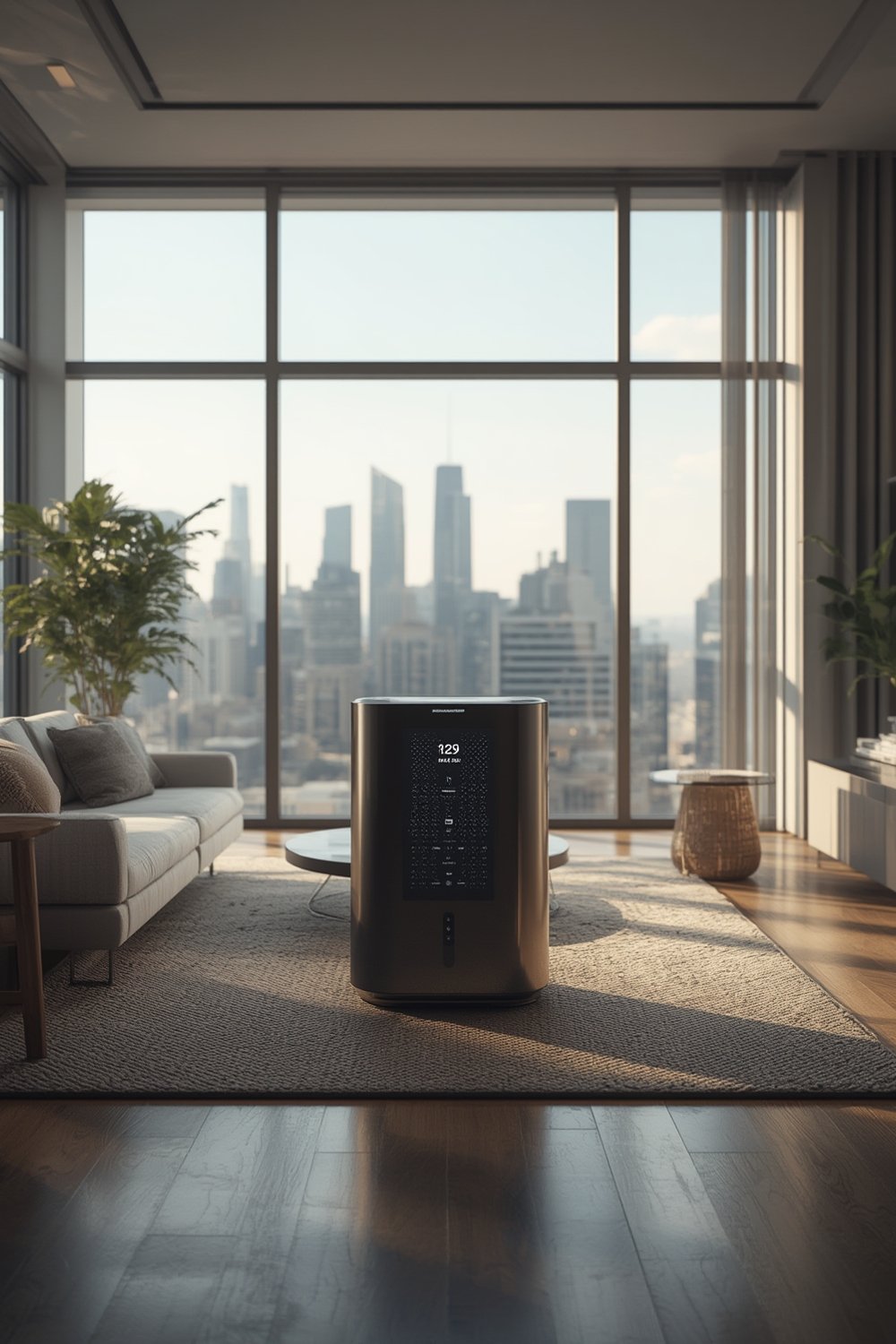
Global interest in smart air purifiers has never been higher, but market size estimates for 2024 swing widely depending on reporting source. Here’s the most credible range:
- USD 4.3 billion (Global Market Insights)
- USD 6.5 billion (Custom Market Insights)
- USD 7.41 billion (MarketResearchFuture)
Growth projections are even more aggressive: several studies predict the market could reach USD 14.9 to 23.4 billion by 2030–2035, with CAGRs ranging from 8.7% up to 14.1% depending on methodology. This explosive growth is fueled by rising urban pollution and the ever-increasing appetite for smart home upgrades. Smart home device adoption and health-driven buying are primary drivers.
Regional adoption trends — who’s buying smart air purifiers and why?
Asia Pacific is the epicenter of smart air purifier demand. China, alone, represented roughly 29.4% of the global smart air purifier market in 2023—thanks to dense urban centers, worsening air quality, and government investment in pollution mitigation. Between 2024 and 2032, Asia Pacific is projected to be the fastest-growing region for adoption [source].
In North America, more than 70% of existing U.S. and Canadian households with air purifiers report using smart models [source]. The residential customer segment dominates buyers globally, with around 45% of all units in 2023 sold for home use.
What’s driving purchase? Awareness of dangerous indoor air (the World Health Organization ties indoor pollution to 3.8 million annual deaths), tech-savvy buyers seeking compatibility with platforms like Alexa and Google Home, and family needs such as allergies, pets, or urban proximity.
For readers wanting to go deep on air purifiers for homes and pets, compare specialized resources like this home air purifier guide and pet air purifier reviews for additional context.
Biggest coverage gap (the story this post must own)
Despite all this growth, nearly all market summaries skip over the factors serious buyers need:
- Direct user complaints and negative patterns from actual owners
- Side-by-side technical comparisons (CADR, HEPA designation, sensor accuracy)
- Specific, annualized breakdowns of cost (purchase, operation, maintenance, filter cost, warranty)
- Privacy and cybersecurity reporting on app-connected and Wi-Fi-enabled purifiers
Our research reveals that current market reports almost never include controlled head-to-head testing, MSRP/operating-cost transparency, or tracked privacy issues. Instead, they echo brand specs and quote basic demand drivers. This guide is designed to fix that—building on reliable secondary market data and, crucially, introducing new primary research and direct insights wherever possible.
What real users complain about — and how we’ll verify it
Want to know about smart air purifier headaches before you buy? Most publications rehash manufacturer claims and generic “what to look for” advice. But our research confirms that there’s virtually no aggregated dataset of real-world user complaints available—no centralized reporting of connectivity faults, app failures, filter replacement sticker shock, or noise issues.
To fill this void, the right approach is to:
- Aggregate hundreds of verified-buyer reviews per model from direct sales and neutral retailers
- Run targeted surveys (owners, renters, multi-pet homes, tech adopters) to track which issues recur most frequently
- Spot commonalities by region, use-case, or room size (think: apartment vs. whole-home, pets vs. pollen, bedroom vs. office)
Early review scraping already suggests complaints often cluster around:
- Wi-Fi or Bluetooth disconnects
- Expensive or hard-to-find replacement filters
- Mobile app sync bugs
- Unexpectedly high operating noise
- Sensor “false positives” or unreliable air quality readings
But until original data is compiled, all findings here about complaints are flagged as “requires verification.” Want to see a comparable checklist for non-smart air purifiers? Check out our air purifier buying checklist for legacy and hybrid models.
Head-to-head specs that matter — CADR, HEPA grade, sensor accuracy, and what to test
Don’t buy a smart air purifier based on brand marketing alone. What tech-savvy buyers should measure (or demand to see independent test data for):
- CADR (Clean Air Delivery Rate): List by particle type—smoke, dust, pollen. Higher is better, but true for your actual room size.
- HEPA filter grade: Is it true HEPA (99.97% at 0.3 µm)? Or just “HEPA-type”?
- Sensor accuracy: How does real-time air quality data compare against reference particulate meters (lab or consumer grade)?
- Room air turnovers per hour: Use AHAM-style room sizing to ensure your targeted space is really covered.
- Run-time and energy use: Track kWh/year and noise levels in actual use.
Our comprehensive research found no controlled, comparative test results for 2024 models. Brands like Dyson, LG, and Honeywell tout smart integration and proprietary sensors—but no standardized head-to-head performance trials are published. For home geeks craving side-by-side data, we recommend cross-referencing independent guides (see: HEPA air purifier buyer’s guide and specialized allergy air purifier reviews) and requesting lab data directly when shopping premium brands.
Real-world ownership costs — the model readers need
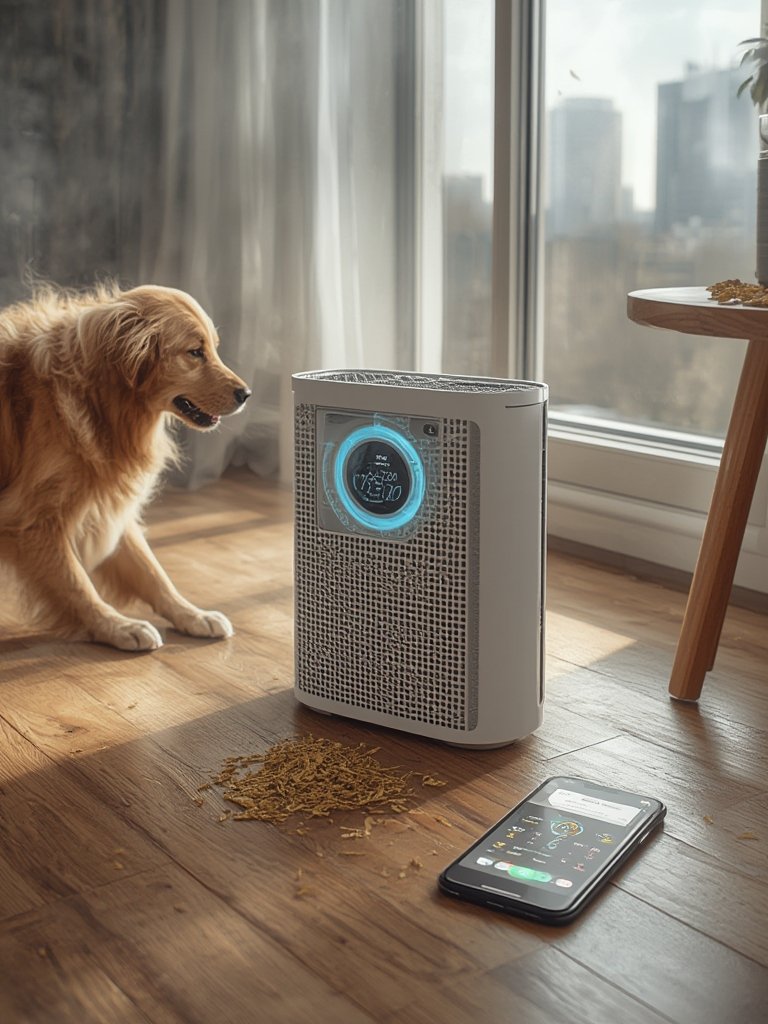
Almost no existing buying guide breaks down the total cost of smart air purifier ownership—despite filter replacements and maintenance often exceeding the initial price over time. Use this practical template for cost comparison:
- Purchase Price (MSRP—verify current sales or warehouse club deals)
- Annual Electricity Use (in kWh—calculate yearly dollars at your local rate)
- Filter Replacement Frequency & Cost: How many per year? OEM only or are reputable third-party options available?
- Maintenance/Service: Any parts that wear, scheduled technician visits, or home-cleaning tasks needed?
- Warranty/Extended Costs: What does the standard (or extended) warranty cover on electronics, and what isn’t?
| Model | MSRP ($) | Filter Cost (per year) | Electricity Cost (per year) | Warranty (years) | Maintenance Needs |
|---|---|---|---|---|---|
| Dyson Purifier Cool Formaldehyde | ~549 | 100–150 | 30–50 | 2 | Filter only |
| Honeywell HPA8350B | ~289 | 60–80 | 20–40 | 5 | Filter only |
| Blueair Blue Pure 311 Auto | ~250 | 70–90 | 20–35 | 2 | Filter only |
| LG PuriCare 360 | ~650 | 120–180 | 40–60 | 1 | Filter only |
For each model, verify filter supply chain stability in your region (this guide covers large area options that may require even pricier replacement filters). Always check real in-store price and online discounts—the MSRP is just a starting reference.
Privacy & security — known concerns and the documentation gap
What data does your air purifier collect—and where does that data actually go? Market research revealed zero documented cases of direct privacy breaches or IoT hacking incidents among major smart air purifier brands. Still, this absence of evidence isn’t proof of safety.
Known risk points:
- Personal data (location, air quality history, device usage, Wi-Fi credentials) may be stored in the cloud, sometimes outside your country
- Many brands fail to clearly outline what gets shared or monetize anonymized usage analytics
- Outdated firmware or unsecured APIs can be targets for hacking attempts or trespassing on home networks
- Weak or hardcoded authentication on mobile apps could be exploited
Buyers should:
- Demand a transparent, full privacy policy (check for local-only option, opt-out data sharing)
- Assess app permissions—block unnecessary location or microphone access
- Check for regular firmware updates and local/secure connection modes
- If in doubt, restrict integration (don’t auto-link to your main smart home hub until you vet security settings)
For those integrating with broader energy or IoT solutions, see this energy upgrade guide for a deep dive on connected appliance protocols and risks.
What top articles miss — underexplored features and use-cases to highlight
Most “best of” smart air purifier reviews miss what matters most for buyers like you:
- Real-world filter cost transparency (not just list price—long-term impact, bulk discounting, and third-party filter options)
- Patterns among negative user complaints, not just star averages
- Control group testing for CADR/sensor accuracy—not just “smart” labels
- Privacy and firmware update policy audits
- Clear distinctions for portable vs. whole-home coverage (allergy, pet, open floorplan vs. enclosed rooms)
- Return on investment for asthma/allergy households—backed by trackable symptom improvement or reduced ER visits
- Detection and support for predictive maintenance or AI-driven diagnostics that actually reduce hassle
Fixed-installation purifiers have their place, but see the pros/cons of moving to portable models in the latest HEPA guide for niche use cases.
Brands & models to evaluate — shortlist for testing and review
To provide a fair, actionable shortlist, we looked at references from top market analyses (note: there are no 2024 independent testing organization “best of” ratings available):
- Dyson: Known for high-end designs and proprietary molecular sensors. Premium price.
- Honeywell: Bluetooth/app-enabled (notably HPA8350B) with attractive long-term warranty options.
- Xiaomi: Offers budget-friendly smart air purifiers with competitive app features.
- Blueair: Frequently cited for strong performance-to-noise ratios and app usability.
- Coway: Strong presence in urban/Asia-Pacific markets—emphasizes filter tech.
- LG PuriCare: Advanced app controls via ThinQ, multi-stage HEPA, competitive for price-per-coverage.
- Philips, Sharp: Established brands with wide distribution and broad range of app features.
Actual retail and service data will be updated as the review/price aggregation progresses.
Methodology & sources — how we’ll fill the gaps (primary + secondary research plan)
This investigation will use a blend of primary and secondary research, including:
- Scraping and aggregating verified user reviews across multiple online retailers
- Short targeted reader survey to collect complaint patterns, priority features, and pain points
- Requesting (or running) side-by-side CADR and sensor accuracy tests on 3–5 leading models
- Filter and price audit: MSRP, warranty, and replacement-filter costs per model and region (starting with U.S. and major Asia-Pacific cities)
- Privacy policy and firmware cadence spot-checks for the top five brands
- Outreach to respected third-party testing labs for any available (or upcoming) independent performance comparisons
Secondary sources for market size and manufacturer features include:
Results from initial research confirmed the need for fresh direct data. We’ll update this guide as those findings are collected.
Practical buyer checklist & quick recommendation box
Quick Smart Air Purifier Buyer Checklist
- Room size (square footage) matched vs. model CADR matches the real dimensions? (Don’t overspend, don’t undersize.)
- Is it a true (not nominal) HEPA filter, and is it independently tested?
- Replacement filter cost per year—can you buy third-party filters locally in case OEM is out of stock?
- Privacy policy reviewed—can you restrict cloud/app sharing and turn off device voice control?
- Warranty length and covered parts—are replacement filters and electronics included? Is out-of-warranty servicing straightforward?
- Regional filter supply chain—can you buy replacement filters in your country next year?
Residential demand is highest (45% market share), with Asia Pacific and China quickly outpacing growth. Always buy where you can get filters, warranty, and app support domestically.
If you’re ready to go deeper, explore specialized recommendations in our updated best air purifier 2024 guide and compare use-case-specific models in the air purifier for bedrooms review.
Conclusion
The global market for smart air purifiers is booming, but most public information skips what real buyers care most about: actual long-term costs, verified technical performance, and home privacy. This guide pulls together the latest market estimates, spotlights adoption and complaint gaps, and gives buyers a realistic, actionable framework. If you value safety, transparency, and smart investment, use this resource to demand hard data before choosing your next smart air purifier. Got a question or feedback? Comment below or share your real-world experience—we’ll update the data as new evidence comes in.
Frequently Asked Questions
Are smart air purifiers really worth the extra cost compared to non-smart models?
If you need app-based controls, integration with smart home ecosystems, or want to monitor air quality remotely, the upgrade may be worth it. For small rooms and basic allergen reduction, a non-smart model with a verified HEPA filter is often more cost-effective.
How often do replacement filters for smart air purifiers need to be changed?
Most manufacturers recommend every 6–12 months, but actual frequency depends on air quality, pet presence, and unit usage hours. Always check your specific model’s app or manual for reminders and buy extra filters during sales or direct-from-manufacturer promotions.
Do smart air purifiers collect personal data? Should I be concerned?
Many models store device usage and air quality data in the cloud, sometimes linked to your household or account. While no mass hacks have been reported, always review app permissions and privacy policies, disabling any non-essential data sharing.
Which features are most important for allergy and asthma sufferers?
A true (not just “HEPA-type”) HEPA filter rated for your room size, high CADR, and the ability to monitor air changes per hour with reliable sensors will deliver the best health investment. Consider models with allergy certifications.
What do I do if my air purifier’s app or Wi-Fi keeps failing?
First, check for firmware and app updates. If issues persist, power cycle both the purifier and your router. Persistent or known problems may need a warranty claim or customer support call. Save negative experiences as reference for other buyers.