

Portable air purifier buyers in 2024 face a crowded market, confusing specs, and a lack of clear, actionable advice on real-world costs and durability. This guide fills critical gaps missed by top articles—giving you the facts and research-backed steps to make the right choice for your home and health.
Key Takeaways
- Market data shows portable air purifier sales are soaring, but credible, consistent info on leading brands and lifetime costs is lacking.
- HEPA and activated carbon filters offer clear benefits for particle and odor removal, but costs and specs vary—a standardized comparison is essential.
- Actionable buying means looking past marketing: check verified reviews, compare specs (CADR, noise, energy), and estimate true ownership costs before you purchase.
- Market overview — size, growth, and regional share
- Leading brands and why top lists are inconsistent
- What reviewers and top-ranking articles miss
- Top user complaints and durability issues
- Technical-spec comparison framework
- Effectiveness by pollutant (PM2.5, VOCs, allergens, viruses)
- Costs — purchase, filter replacement, and annual operating costs
- Safety, regulations, and official guidance
- Buyer checklist — how to choose a portable air purifier
- Methodology and sources to validate gaps
- Conclusion
- FAQ
Market overview — size, growth, and regional share
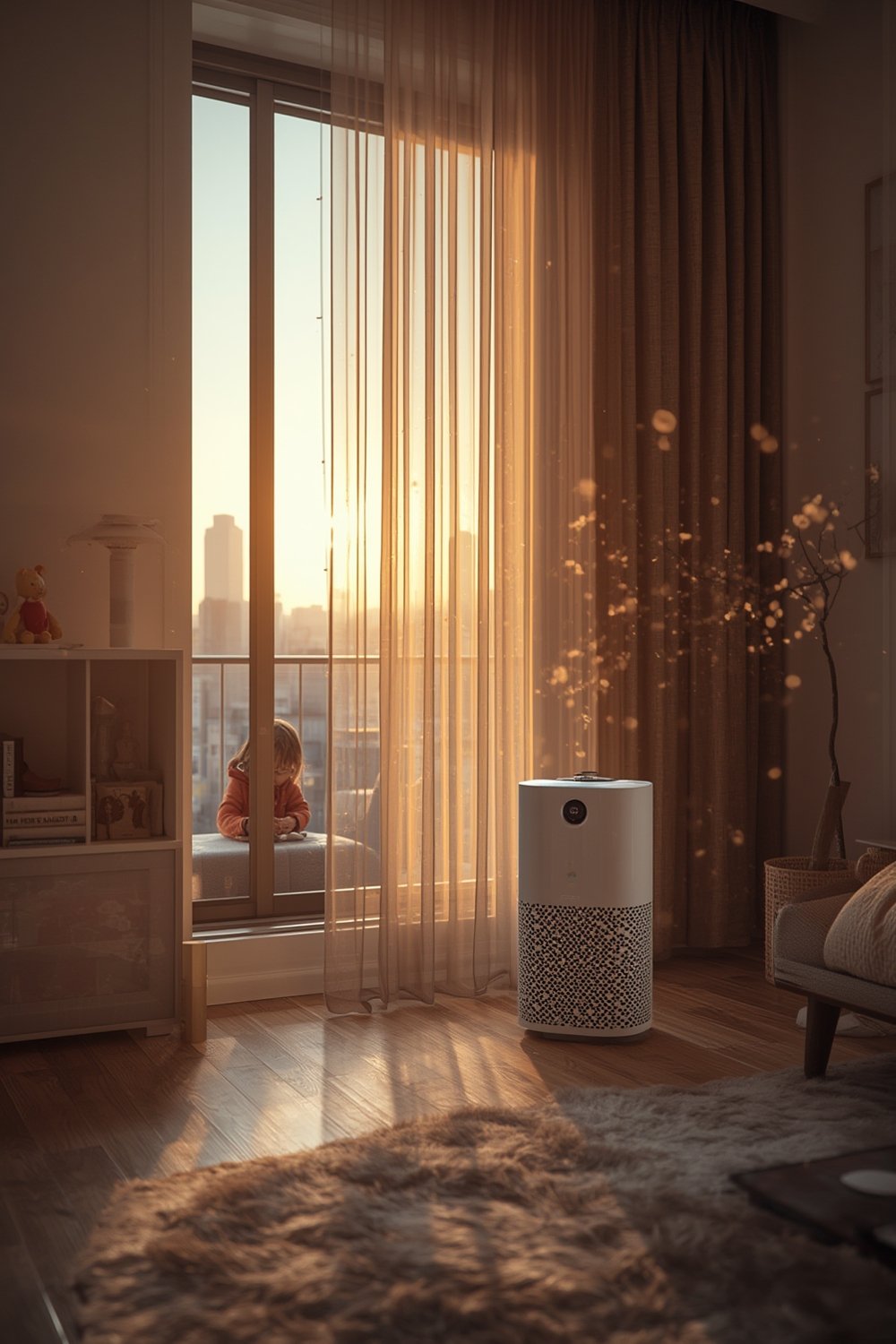
The portable air purifier market is booming, but data varies widely by analyst. Global estimates for 2024 range from USD 11.92B, USD 9.31B, to USD 13.97B. Growth projections differ: 6.14 to 7.9% compound annual growth rate (CAGR) through 2033-2035. For example, one source forecasts 7.0% CAGR to USD 22.13B by 2033. Asia Pacific controlled about 41% of global sales in 2024, primarily driven by urbanization and pollution.
Leading brands and why top lists are inconsistent
Unlike in many product categories, research into portable air purifiers did not reveal a consistent set of leading brands for 2024. This inconsistency likely comes from rapid product churn (models and brands changing fast), strong regional manufacturers, and a lack of transparent reporting or global benchmarking.
What should you look for if “best brand” lists vary everywhere? Prioritize brands with full disclosure of independent testing data, clear warranty and support policies, and significant verified buyer feedback—especially from U.S. and Asia Pacific markets, where most sales occur. Pay close attention to established names in appliances and air quality rather than social media trends. See our Best Air Purifier 2024 guide for deeper picks and brand analyses when available.
What reviewers and top-ranking articles miss
Most high-ranking buying guides for portable air purifiers lack substance on three crucial issues:
- Verified buyer complaints and real-world durability. Without robust negative feedback data, you can’t know which models break or disappoint after months of use.
- Tangible annual cost estimates (purchase, filters, energy). Lifetime cost is a big factor for budget-aware buyers but is often ignored or glossed over.
- Side-by-side technical comparisons (CADR, noise, energy, pollutant removal). Specs are rarely standardized, making apples-to-apples comparison nearly impossible for consumers.
This guide details how to fill those actionable gaps, enabling smarter decisions for urban families and renters. For a general buying checklist, see also our air purifier buying checklist.
Top user complaints and durability issues — what we know and how to gather missing data
The research identified one key truth: there’s a lack of aggregated and statistically reliable data on durability and user complaints. No study provided a breakdown of verified-buyer complaints or negative review trends for portable air purifiers.
To uncover actual complaints, use these data sources and methods:
- Read Amazon “Verified Purchase” reviews and use filtering tools (e.g., FakeSpot, ReviewMeta) to screen for authenticity and patterns.
- Check review aggregators on Best Buy and Home Depot, where buyers report filter costs, noise, and reliability.
- Consult Consumer Reports “reliability” and “owner satisfaction” scores for lab-tested brands.
- Look into warranty claim data when available, or manufacturer-reported defect/return rates.
The most common complaint categories typically include:
- High noise or annoying sound at night
- High filter replacement cost or supply issues
- Short device lifespan or sudden breakdown
- Loss of cleaning performance over time
- Ozone or “burnt” smell with ionizer-equipped models
Readers concerned about allergy relief or bedroom safety can dive into the air purifier for bedroom guide for more detail.
Technical-spec comparison framework (CADR, filtration tech, noise, energy) — what to report and why
When evaluating any portable air purifier, insist on these critical specs for fair comparison:
- CADR (Clean Air Delivery Rate): The higher, the better for your specific room size. The spec should be reported in CFM (cubic feet per minute) and matched to the actual square footage of your bedroom or living space.
- Filtration Type: True HEPA (certified to 99.97% efficiency for 0.3 micron) is essential for allergy and asthma, while similar-sounding filters (“HEPA-type”, “HEPA-like”) typically fall short. HEPA now dominates portable air purifier market share (41.4%–48.9%) [Source].
- activated carbon filters: Required for removing gases, odors, and VOCs. This tech is the fastest-growing segment (8.2–9.17% CAGR) [Source].
- Noise Level: Should be measured in decibels (dB) at typical fan speeds. Under 30–35 dB is best for sleep; higher settings may exceed comfort levels.
- Energy Use: Report in watts (W), and estimate annual usage for your area (typical usage: 8–24h/day).
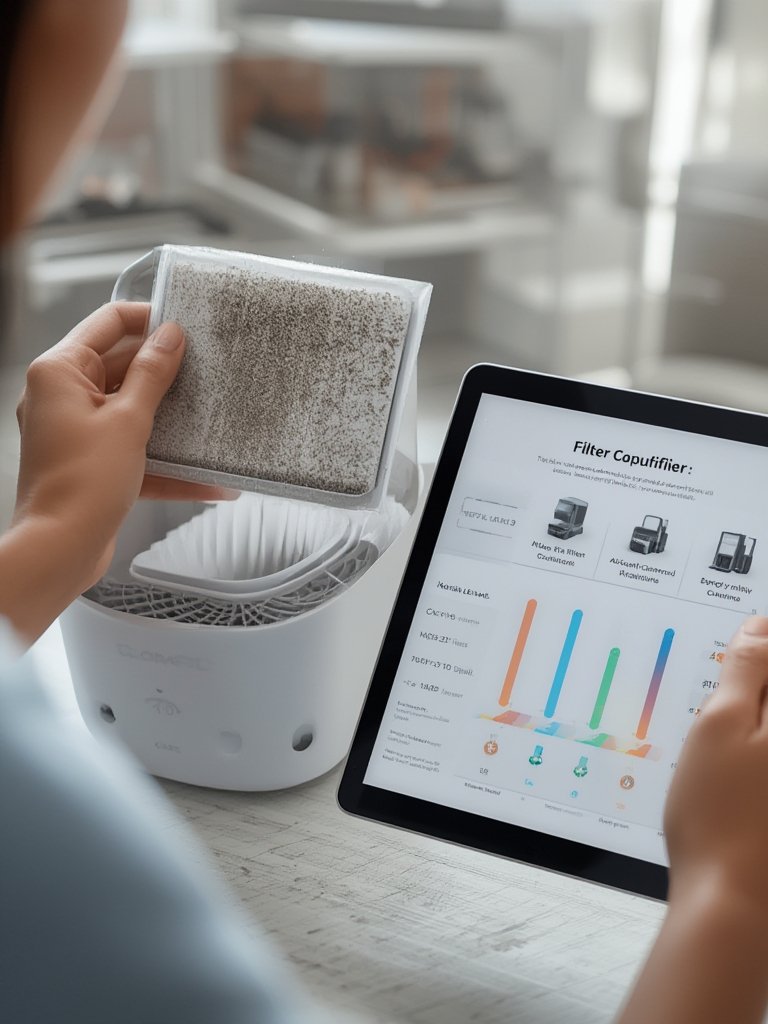
Specification differences matter. For allergy relief, prioritize highest HEPA CADR, then activated carbon for odors and smoke. Lower noise and lower energy use are essential for bedrooms and rental spaces where 24/7 operation is common.
For a quick look at advanced spec rundown and use-case matching, check our air purifier large room and air purifier for allergies guides.
Effectiveness by pollutant (PM2.5, VOCs, allergens, viruses) — evidence summary and limits
Evidence shows that:
- HEPA filters reliably capture particles down to 0.3 microns at ~99.97% efficiency—great for PM2.5, dust, pollen, and pet dander. [Source]
- Activated carbon absorbes volatile organic compounds (VOCs), odors (from pets or cooking), and some gases. This matches the fastest-growing segment in the air purifier market [Source].
- Viruses and bacteria: No consolidated peer-reviewed studies confirm consistent virus removal in home-use portable air purifiers in 2024. HEPA likely helps, but is not a substitute for ventilation or medical-grade cleaning.
Set practical expectations: Air purifiers improve indoor air quality for particles and odors, but are only one part of a healthy home strategy. Source control and ventilation remain important. See our deep-dive HEPA air purifier buyers’ guide for allergy/asthma notes.
Costs — purchase, filter replacement, and annual operating costs (what we’re missing and how to estimate)
Despite buyer interest, research produced no direct cost breakdowns for portable air purifiers. Here’s a step-by-step approach to estimate true total cost of ownership:
- Initial Price: Portable HEPA air purifiers for bedrooms usually range from $80–$300.
- Filter Replacement: Find manufacturer’s stated lifespan (usually 6–12 months for HEPA, 3–6 months for carbon). Estimate annual filter costs by multiplying replacement frequency by filter set price (often $25–$90 per set).
- Electricity: Note device wattage. For example, a 38W unit running 12 hours/day: 0.038 kW × 12 × 365 = 166 kWh/year. At $0.16/kWh (US average), that’s ~$27/year.
Example Total Annual Cost: $150 purchase, $45/year filters, $27/year electricity = $72/year after first year (excluding device replacement).
Check utility calculators or energy-efficient upgrade guides for local power rates.
Safety, regulations, and official guidance (EPA, WHO, and other regulators)
Government agencies are tightening controls on air purifiers that emit ozone—particularly ionic and some UV-C models. U.S./EU authorities have set lower emission thresholds and launched consumer warnings. No official 2024 EPA or WHO guidance on portable air purifiers was found in the reviewed research.
As a buyer, avoid models that use ionizers, especially for bedrooms or homes with kids. Prioritize “ozone free” labeling and third-party testing. For more on regulation impacts and home improvement integration, see our Energy Efficient Upgrades Guide.
Buyer checklist — how to choose a portable air purifier in 2024
- Match CADR rating to your actual room size (calculate: see product spec, or use AHAM Room Size Calculator tools).
- Insist on “True HEPA” (not “HEPA-type”) for particles and allergens.
- Choose models with activated carbon filters for odor and VOC removal—highly recommended for homes with kids, pets, or smokers.
- Skip ionizer/ozone-based devices; verify “zero ozone” on certification labels.
- Check noise ratings in decibels—30–35 dB max for bedroom use.
- Research filter replacement costs and schedules for next 2–3 years before buying.
- Review warranty policies and favor models/brands with ample “verified buyer” complaints data available.
Our pet air purifier buying guide and air purifier for home cover additional scenarios.
Methodology and sources to validate gaps
Use this research-first methodology for an authentic, data-backed buying decision—or to write your own review that fills the gaps current articles miss:
- Pull detailed verified buyer reviews from Amazon, Best Buy, Home Depot; export or scrape datasets for complaint analysis.
- Request or access independent test lab reports (AHAM Verified, Consumer Reports, ISO test standards) for CADR, noise, and energy use.
- Search peer-reviewed academic literature for pollutant-removal performance of main filter types (PubMed, ScienceDirect).
- Calculate annual operating cost using model wattage, hours of use, and local utility rate (check utility websites or federal energy calculators).
- Review regulatory agency websites (US EPA, California CARB, European Commission) for the latest rules and safe-use guidance.
Every portable air purifier recommendation on this site follows this method—and actively works to close known data gaps for real users.
| Spec | Why It Matters | How To Check |
|---|---|---|
| CADR | Determines effective room size; higher = faster air cleaning | Label/spec sheet or AHAM Verified site |
| Filter type | HEPA for particles, carbon for odors/VOCs | Manual, product page, photos |
| Noise (dB) | Comfort for sleeping, working, family use | Lab test, reviews, spec sheet |
| Energy draw (W) | Total cost & environmental impact | Specs, watt meter, EPA label |
| Filter cost/life | Major ownership expense, supply issues | Brand site, major retailer listings, buyer reviews |
| Warranty/returns | Risk protection for budget buyers | Warranty card/box, user manual |
Conclusion
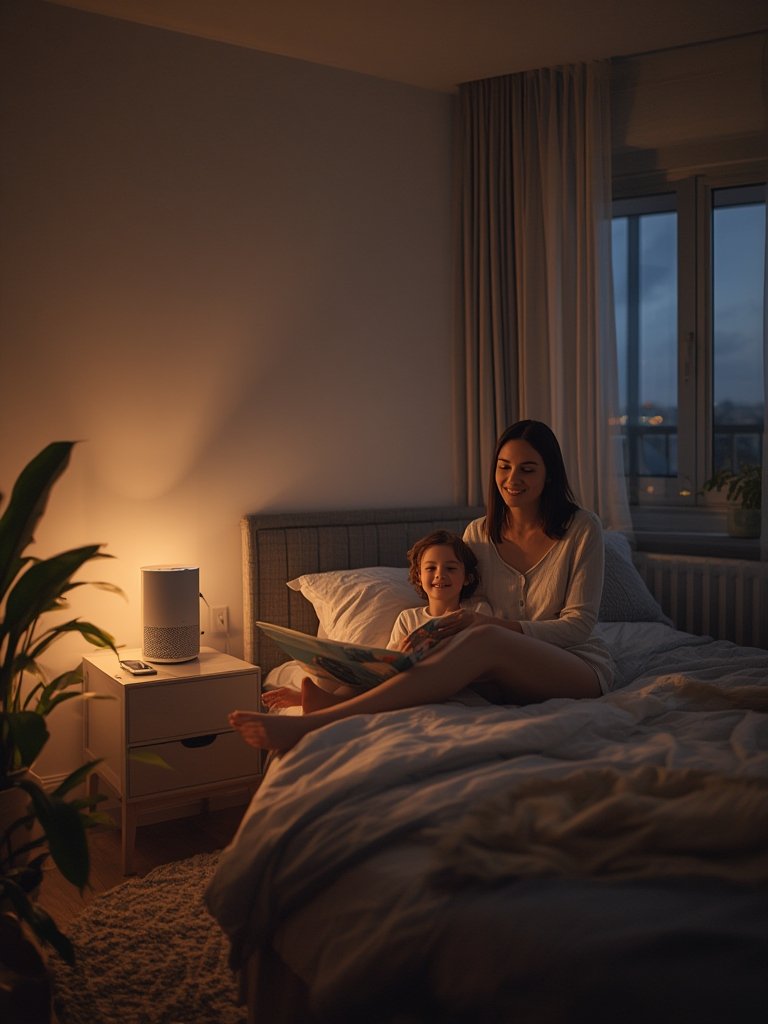
Choosing the right portable air purifier is about much more than a spec sheet or influencer list. If you want cleaner air and fewer allergens for your family, use independent data, scrutinize filter and energy costs, and rely on real-world complaint patterns—not just best-seller status. The best portable air purifier for your bedroom or living space is the one that matches your actual needs, budget, and quality expectations over time. Ready to compare top picks? Explore our latest air purifier for home guide or start with the actionable checklist above.
Frequently Asked Questions
How do I match a portable air purifier’s CADR to my room size?
Find the model’s Clean Air Delivery Rate (CADR) for smoke or dust. For bedrooms and living spaces, multiply your room’s square footage by 2/3 to estimate minimum needed CADR in CFM (for example, a 150 sq ft room needs about 100 CFM CADR).
Are HEPA filters better than “HEPA-type” or “HEPA-like” filters?
Yes—“True HEPA” certified filters remove 99.97% of 0.3-micron particles and are proven by independent tests. “HEPA-type” or “HEPA-like” are marketing terms with lower, unverified efficiency.
How much will a portable air purifier cost to run each year including filter replacement?
Budget $70–$100 per year for bedroom models (including filter changes and electricity). Always check the specific filter replacement schedule, price, and wattage for your pick.
Is a portable air purifier safe to use all night in a child’s bedroom?
Yes, as long as it uses a mechanical HEPA/carbon filter and is certified “ozone free.” Avoid ionizer-equipped models for nighttime or children’s use.
Where can I check verified buyer complaints before purchasing?
Review Amazon and Best Buy “verified purchase” feedback, preferably posts after several months’ ownership. Search for model, filter, and noise complaints for a full picture.