

Looking for the best air purifier for smoke in your home? Here’s a science-backed guide for anyone living in wildfire-prone regions or with frequent indoor smoke. Real lab data, actionable advice, and critical pitfalls—without the fluff.
Key Takeaways
- Top HEPA air purifiers can reduce smoke particles by up to 85% in lab testing and about 79-82% in real homes during 24-hour wildfire events.
- Choose HEPA H13 or H14, ensure high CADR for smoke, and get ample activated carbon for best results; not all technologies or models work equally well.
- 2024 market lacks reliable cost, complaint, and demand data—always check for verified test results, lab-verified specs, and filter replacement intervals before buying.
- Why this guide matters now
- How effective are top-rated air purifiers at removing smoke particles?
- Which filter technologies actually work for smoke? HEPA, activated carbon, and other tech
- Key technical specs that determine smoke performance
- How leading models compare
- Buying checklist—how to size and choose an air purifier for smoke
- Costs, filters and maintenance—what buyers need to know
- Common consumer complaints and limitations when using purifiers for smoke
- Three important sub-topics many competitor articles miss
- Practical usage tips and DIY/temporary solutions during heavy smoke events
- What to ask manufacturers and independent testers
- FAQ: Air Purifier for Smoke
Why this guide matters now
Making the right decision about an air purifier for smoke has never been more urgent. Wildfire seasons have grown longer, and health risks from indoor and outdoor smoke are increasingly recognized. Homeowners and renters are searching for solutions, but the available research reveals both strong proof and worrisome data gaps.
Lab and real-world studies show that a quality air purifier for smoke can dramatically reduce harmful particles indoors. Yet there are no comprehensive 2024 statistics summarizing nationwide smoke exposure or measuring the surge in air purifier demand, nor is there centralized cost or complaint data for recent purchases. That means while you can buy with more confidence than ever if you know what to look for, you must trust only independently tested specs—not advertising claims.
How effective are top-rated air purifiers at removing smoke particles?
Let’s cut right to the evidence. Lab testing by Consumer Reports confirms that the best HEPA-equipped air purifiers can cut airborne smoke particle counts by up to 85%. This includes both tiny wildfire particles and cigarette smoke as small as 0.1 microns.
But the real-world story is almost as good. An independent peer-reviewed study found that portable HEPA air cleaners lowered PM2.5 reduction (the dangerous fine particles found in smoke) by about 79-82% over 24 hours in actual homes during smoke events. That means most of the dangerous smoke you breathe indoors can be removed if you choose and use your purifier correctly.
There is a slight gap between the “up to 85%” reduction found in laboratory controlled spaces and the ~79-82% PM2.5 drop measured in everyday living situations. Factors like home ventilation, open doors, and air leaks can explain the difference. Still, that’s outstanding performance for a practical investment—if you buy the right technology and size for your space.
Which filter technologies actually work for smoke? HEPA, activated carbon, and other tech
Not every filter can handle smoke effectively. Here’s a breakdown of what works—and what to avoid:
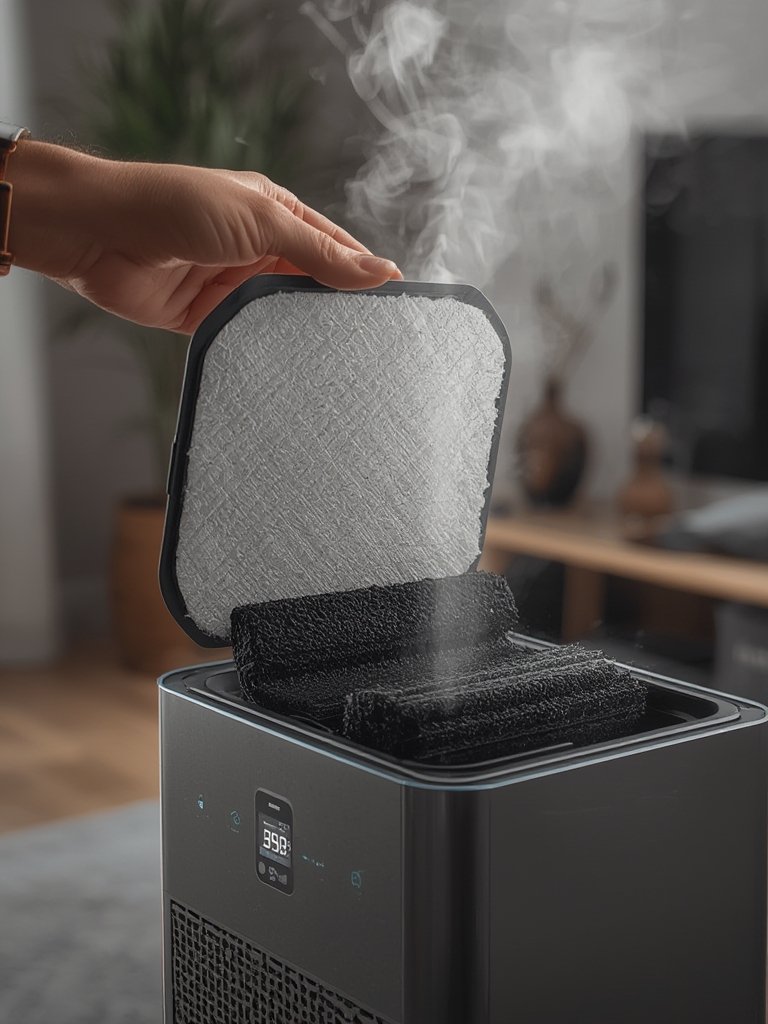
- HEPA (High Efficiency Particulate Air): The backbone of any high-performing air purifier for smoke. A true HEPA filter removes at least 99.97% of particles down to 0.3 microns. Higher-grade filters (H13/H14) capture 99.95-99.995% of even smaller (~0.2 micron) particles. This is the gold standard, confirmed by Consumer Reports and real-world field studies.
- Activated Carbon: Smoke particles don’t always mean “smoke smell.” Odors and toxic gases ride the smallest, hardest-to-capture molecules—called volatile organic compounds, or VOCs. An ample activated carbon stage is necessary to absorb these compounds. Always choose models with large carbon beds, not thin “deodorizer” pads.
- Other technologies (ionizers, UV, electrostatic): These are rarely proven for effective smoke removal. Ionizers may release ozone (a respiratory irritant). UV and electrostatic methods may offer benefits in hospital or industrial settings, but not in everyday home smoke scenarios—and none have shown direct PM or odor removal in independent tests focused on wildfire smoke.
If you need more technical background on HEPA technology, check our dedicated HEPA air purifier buyer’s guide.
Key technical specs that determine smoke performance
Don’t shop blind. Even among “HEPA” units, smoke performance hinges on key specs:
- CADR (Clean Air Delivery Rate) for Smoke: Indicates how quickly the unit removes smoke particles. Top portables in recent studies measured 263–348 cubic feet per minute (cfm). Larger commercial units can hit 200–1200 m³/h (about 118–706 cfm).
- ACH (Air Changes per Hour): Tells you whether your purifier can clean your actual room volume multiple times each hour. For heavy smoke, aim for 4-6 ACH.
- HEPA filter grade: H13 or H14 is most reliable for fine smoke. Confirm the filter is independently certified—not just “HEPA-like.”
- Activated carbon amount: The more carbon (measured in grams or pounds), the longer it will effectively adsorb odors and VOCs from smoke.
- Fan power: A large filter is useless if the fan cannot move enough air through it. Bigger, high-wattage fans give you faster results, especially in large rooms.
Read more about matching your purifier to the room in our air purifier large room guide.
How leading models compare
Model shopping is tough, as marketing claims often exaggerate. Use this simple, direct comparison method:
| Model/Source | CADR for Smoke | Filter Type | Particle Size Removal | Room Size |
|---|---|---|---|---|
| Consumer Reports Top-Rated Source |
High (not specified) | HEPA + Carbon | 0.1 micron+ | ≥350 sq ft |
| HEPA PAC (Real-World Study) Study |
263–348 cfm (measured) | HEPA | 0.3 micron (99.97%) |
N/A |
| Commercial (2024) Source |
200–1200 m³/h (~118–706 cfm) |
HEPA H13/H14 | 0.2 micron (99.95–99.995%) |
100–500 m² |
Check the declared CADR by the manufacturer, but always confirm: Is it for smoke, not just “dust”? Is the HEPA grade independent lab-certified? Is there at least half a kilogram (about 1 lb) of activated carbon? Models that nail these on paper and pass independent smoke tests (like the best air purifiers for 2024) are almost always worth the extra investment.
Buying checklist—how to size and choose an air purifier for smoke
- Measure your room’s length, width, and ceiling height. Multiply to get cubic feet.
- Calculate target CADR: For heavy smoke, aim for at least 4-6 air changes per hour (ACH). Divide room cubic feet by 60, multiply desired ACH, and you get the minimum cfm required.
- HEPA filter: Confirm H13 or H14 for fine smoke. Lower grades (“HEPA-type”) are not reliable.
- Carbon: Prefer models that state the weight or volume of real activated carbon. Thin sheets aren’t enough during wildfire peaks.
- Test results: Only trust units with measured CADR data and independent lab testing. Avoid models that only show “theoretical” or unverified numbers.
Consumer Reports recommends models certified for at least 350 sq ft for wildfire and severe smoke. You can explore more in our air purifier for home guide and our in-depth air purifier buying checklist.
Costs, filters and maintenance—what buyers need to know
What does a great air purifier for smoke really cost in 2024?
- Purchase price: Reliable 2024 average pricing is not available in the current published research. Buyers should expect to pay extra for higher CADR and robust carbon filters.
- Filter replacement: No aggregated data available for filter costs or average service intervals for 2024. Manufacturer specs and retailer listings are your best bet for estimates (budget $30–$120 annually for HEPA, often more for carbon stages).
- Electricity: Higher-powered fans use more energy, but most costs are still minor compared to the health risk of skipping air treatment during smoke events.
- Annual “real” cost: Always include purchase price, replacement filters, and any extra set-up costs. If you’re considering a DIY air cleaner, understand that most studies and EPA coverage do not account for filter replacement costs.
To break down every expense, see our future update or consult current manufacturer/retailer sites.
Common consumer complaints and limitations when using purifiers for smoke
Here are recurring user frustrations that aren’t always clear from product listings:
- Noise: On “high” or “turbo” mode, most air purifiers for smoke get noisy—50–70 dB or more. For bedroom or nursery use, compare noise specs or find verified reviews before choosing.
- Filter Replacement Cost: For some popular models, carbon and HEPA filters must be changed every 6–12 months, and costs add up. Thin carbon beds saturate quickly in heavy smoke.
- Coverage gaps: Many buyers underestimate room volume or choose “whole house” solutions that barely handle a mid-sized room on high.
- Unreliable marketing: Some brands exaggerate coverage or HEPA grade, or market “ozone” or untested filterless tech with little evidence for actual smoke removal.
- Lack of realistic odor control: Too little carbon means odor returns quickly—especially after days of heavy wildfire smoke or persistent indoor cigarette use.
As of now, no comprehensive 2024 roundup of verified user complaints focused on smoke removal is publicly available. Always check multiple user reviews on trusted retailer sites and return policies before choosing a model. For even quieter/lower-maintenance options, browse our quiet air purifier buying advice.
Three important sub-topics many competitor articles miss
- Transparent lifecycle cost: Few guides account for the 2–5 year total cost including filters, carbon, and electricity. Factor in these ongoing expenses for a fair comparison—don’t be surprised by rising costs after purchase.
- Real-world carbon capacity during wildfires: Odor control depends on how much smoke the carbon can adsorb before it is spent. Nearly all reviews miss explaining actual carbon weights or measured odor removal during long smoke events.
- Regional and use-scenario guidance: Sizing for non-stop wildfires versus occasional cigarette use is very different. For continuous wildfire season, larger CADR and carbon volume is mandatory. For light, intermittent indoor smoke, smaller portables may be enough.
Current research and leading buying guides do not address these real-world needs, so use this checklist as your standard.
Practical usage tips and DIY/temporary solutions during heavy smoke events
- Position your air purifier for smoke in the most-used room and as close to the center as possible for fastest particle reduction.
- Seal gap leaks during smoke emergencies—even brief, low-cost window and door sealing with tape or towels can make a dramatic difference.
- For DIY solutions, the EPA and real-world studies confirm that box-fan filters built with high-grade MERV13 or higher can cut PM2.5 about 79-82%. However, DIY filters often miss carbon odor absorption, and their ongoing filter cost is not always disclosed.
- Never use “ionizer only” or ozone-generating units as your primary smoke control device.
- Run purifiers continuously during smoke peaks—delay only risks more exposure.
For more guidance on choosing the right portable solution, visit our portable air purifier guide.
What to ask manufacturers and independent testers
- What is the measured CADR for smoke (in cfm or m³/h)? Is it tested by a credible independent lab?
- What exact HEPA grade is used—H13, H14? Is certification provided?
- How much activated carbon (in grams or pounds) is included?
- Can you provide links to independent lab results or consumer test reports?
- What is the recommended filter replacement interval and typical retail replacement cost?
- What are the measured noise levels on each fan setting?
Use the measured CADR benchmark (263–348 cfm for portable high performers) and confirmed HEPA capture rates (≥99.97% @ 0.3 micron) as your minimum standard when verifying these answers. Read more buying tips in our full air purifier guide for 2024.
FAQ: Air Purifier for Smoke
Will an air purifier remove wildfire smoke from my home?
Yes, a high-quality HEPA air purifier for smoke can reduce airborne smoke particles by up to 85% in lab conditions and achieve 79–82% PM2.5 reduction in real homes, per Consumer Reports and AQJR studies.
Which filter handles odors from smoke?
HEPA catches the particles, but only a robust activated carbon stage removes most smoke odors and VOCs. Look for models that list the carbon amount (more is better for strong or long-lasting smoke).
How long should I run my air purifier during heavy smoke?
Run your purifier continuously (on high, if possible) until indoor air quality returns to safe levels, measured or indicated by your model’s LED or air sensor. For sustained wildfire events, leave it on 24/7.
When is a whole-home air purifier needed?
If smoke infiltration affects multiple rooms or your entire house, use either multiple high-CADR portables (in each main room) or invest in a professionally-installed whole-home unit rated for smoke particles and VOC control. Remember, whole-home models require correct ductwork and maintenance.
How often should I replace filters during wildfire season?
Heavy smoke loads wear out HEPA and carbon filters faster. Check filter status monthly, and follow manufacturer timelines—but change early if odors return or airflow drops.
Conclusion
If you live with wildfire or indoor pollution risk, a high-quality air purifier for smoke makes a real, measurable difference in your family’s air quality. The right unit—HEPA H13 or better, ample carbon, and high CADR verified for smoke—offers up to 85% particle removal, real-world PM2.5 drops of about 79–82%, and improved peace of mind during smoke events. Research reveals gaps in price and complaint data, so prioritize independent lab tests and verified specs. Stay safe: Invest in a truly effective air purifier for smoke this season. Ready to shop? Start your search with our best air purifier for smoke picks for 2024 and protect your indoor air now.