

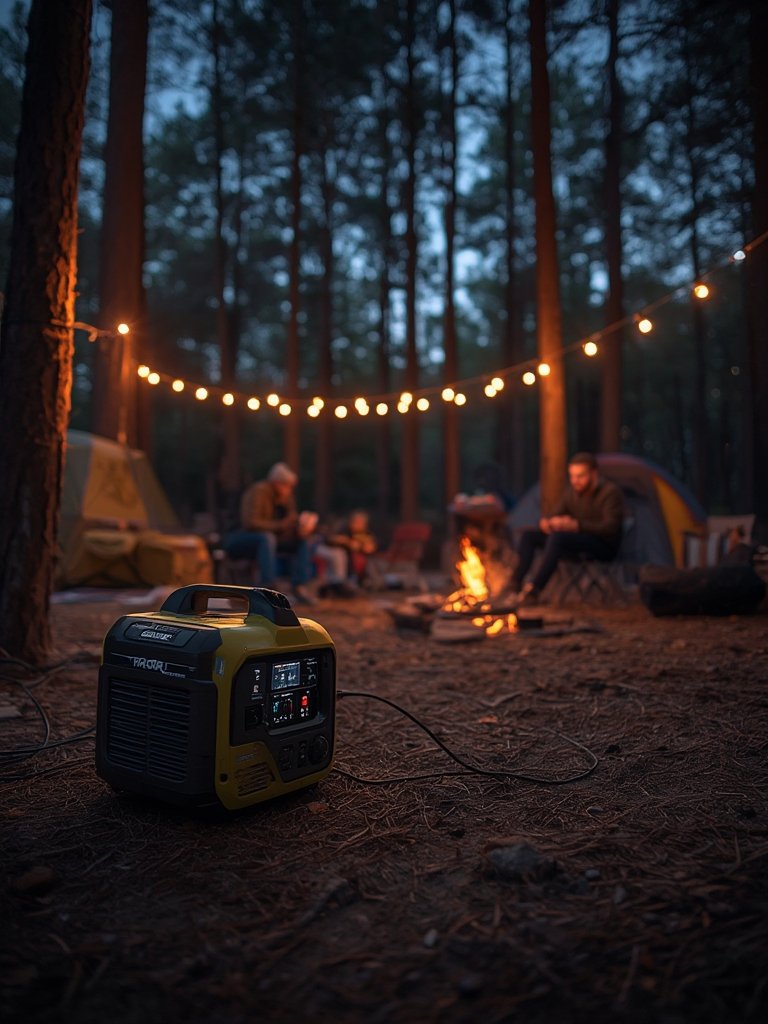
When the power goes out, you have two realistic budget options: a gas (or dual-fuel) generator, or a battery “solar generator”, which is really a portable power station that can be recharged from solar panels. They solve the same problem in very different ways. This guide compares them on the things that actually decide the answer: what you need to run, for how long, where you live and what you can afford.
The short answer
- Choose a solar generator if you mainly need to keep phones, a router, lights, a CPAP, a laptop or a small fridge going for a day or two, you live in an apartment or a place where you can’t run an engine safely, or you also want it for camping.
- Choose a gas or dual-fuel generator if you need to run high-draw appliances (a well pump, a full-size fridge plus a freezer, a window AC, a space heater) through multi-day outages, and you have a safe outdoor place to run it.
- Many households end up with both: a small power station for quiet overnight essentials and a gas generator for heavy daytime loads.
How each one works
A gas generator burns fuel to spin an alternator. As long as you keep adding fuel, it keeps producing power. Inverter models produce clean power safe for electronics and are much quieter than traditional open-frame units.
A solar generator is a lithium battery with a built-in inverter and charge controller. It stores a fixed amount of energy, measured in watt-hours (Wh), and delivers it up to a maximum output, measured in watts (W). You refill it from a wall socket, a car outlet or solar panels. There is no engine, no fuel and no exhaust.
Side-by-side comparison
| Factor | Solar generator (power station) | Gas / dual-fuel generator |
|---|---|---|
| Upfront cost for usable backup | About $400–$1,500 for 1–2 kWh, plus $150–$500 for panels | About $500–$1,200 for a 2,000–4,000 W inverter model |
| Running cost | Near zero (sun or grid recharge) | Fuel, oil changes, stabilizer, spark plugs |
| Output | Typically 1,000–3,000 W continuous | Typically 2,000–9,000 W |
| Runtime | Limited by battery; solar refill is slow | As long as you have fuel |
| Noise | Silent apart from a small fan | About 50–60 dB (inverter) to 70+ dB (open frame) |
| Indoor use | Safe indoors | Never indoors or in a garage: carbon monoxide risk |
| Maintenance | Top up charge every few months | Run monthly, change oil, manage stale fuel |
| Weight | 10–30 kg for 1–2 kWh | 20–50 kg |
Step 1: work out what you actually need to run
Write down the essentials and their running watts (on the appliance label or in the manual). Typical figures:
- Wi-Fi router and modem: 10–20 W
- LED lights: 8–10 W each
- Phone or laptop charging: 10–65 W
- CPAP without humidifier: 30–60 W
- Full-size fridge: 100–200 W while running, with a start-up surge of 600–1,200 W, running about a third of the time
- Chest freezer: 60–100 W running
- Sump or well pump: 750–1,500 W with a large surge
- Window AC: 500–1,200 W
- Space heater: 1,500 W
Then estimate daily energy. A fridge averaging 150 W for 8 hours of actual compressor run time uses about 1.2 kWh per day. Router, lights and phones add perhaps 0.5 kWh. A CPAP for 8 hours adds about 0.4 kWh.
Step 2: match the numbers to each option
Scenario A: apartment, essentials only
Router, phones, a few lights and a CPAP overnight come to roughly 1 kWh per day. A 1–1.5 kWh power station covers a full day and night, silently and indoors. Gas is not an option here anyway.
Scenario B: house, keep the fridge cold for a two-day outage
Fridge plus essentials is about 1.7 kWh per day, 3.4 kWh over two days. That means a 2 kWh station plus 400 W of solar panels on a sunny day, or a larger battery. A 2,000–3,000 W inverter gas generator does the same job for less money, as long as you can run it outside, at least 6 meters (20 feet) from doors and windows.
Scenario C: rural house with a well pump and freezer, outages of several days
High surges and multi-day runtime make this gas or dual-fuel territory. A battery big enough would cost several thousand dollars, and solar panels can’t refill it fast enough in winter.
Solar recharge: be realistic
A 200 W panel rarely produces 200 W. In good summer sun, expect around 60–75% of the rating for the middle hours of the day, so roughly 0.6–0.9 kWh per day from a 200 W panel. On cloudy winter days it can be a quarter of that. Our portable solar panel comparison covers real-world output in more detail.
Total cost over five years
A gas generator is usually cheaper to buy per watt, but fuel adds up during long outages. A 3,000 W inverter model uses roughly 4–6 liters (1–1.5 gallons) of fuel over 8–10 hours at moderate load. For occasional outages, the bigger hidden cost is maintenance: stale fuel gums up carburetors, and a generator that has sat unused for a year often won’t start when you need it. Power stations cost more upfront but have almost no running costs, and modern LiFePO4 batteries are rated for 3,000+ charge cycles, far more than an emergency-only unit will see.
Safety checklist
- Run gas generators outdoors only, far from openings, and install battery-powered carbon monoxide alarms inside.
- Never back-feed your house through a wall socket. Use heavy-duty extension cords, or have an electrician install a transfer switch or inlet box.
- Store fuel in approved containers with stabilizer, away from living spaces.
- Keep power stations away from water, and don’t cover their vents while charging.
FAQ
Can a solar generator run a refrigerator?
Yes, if its continuous output exceeds the fridge’s start-up surge (look for 1,500 W+ for full-size fridges) and the battery is big enough for the hours you need. A 1 kWh unit typically keeps a modern fridge going for 6–10 hours.
Is “solar generator” just marketing?
Mostly. It is a power station sold with, or compatible with, solar panels. The battery capacity and inverter output are what matter.
What about dual-fuel generators?
They run on gasoline or propane. Propane stores for years without going stale, which makes it attractive for emergency-only use, at the cost of a little less output.
For specific models, see our best portable power stations, and for small devices our guide to sizing a power bank in watt-hours.