

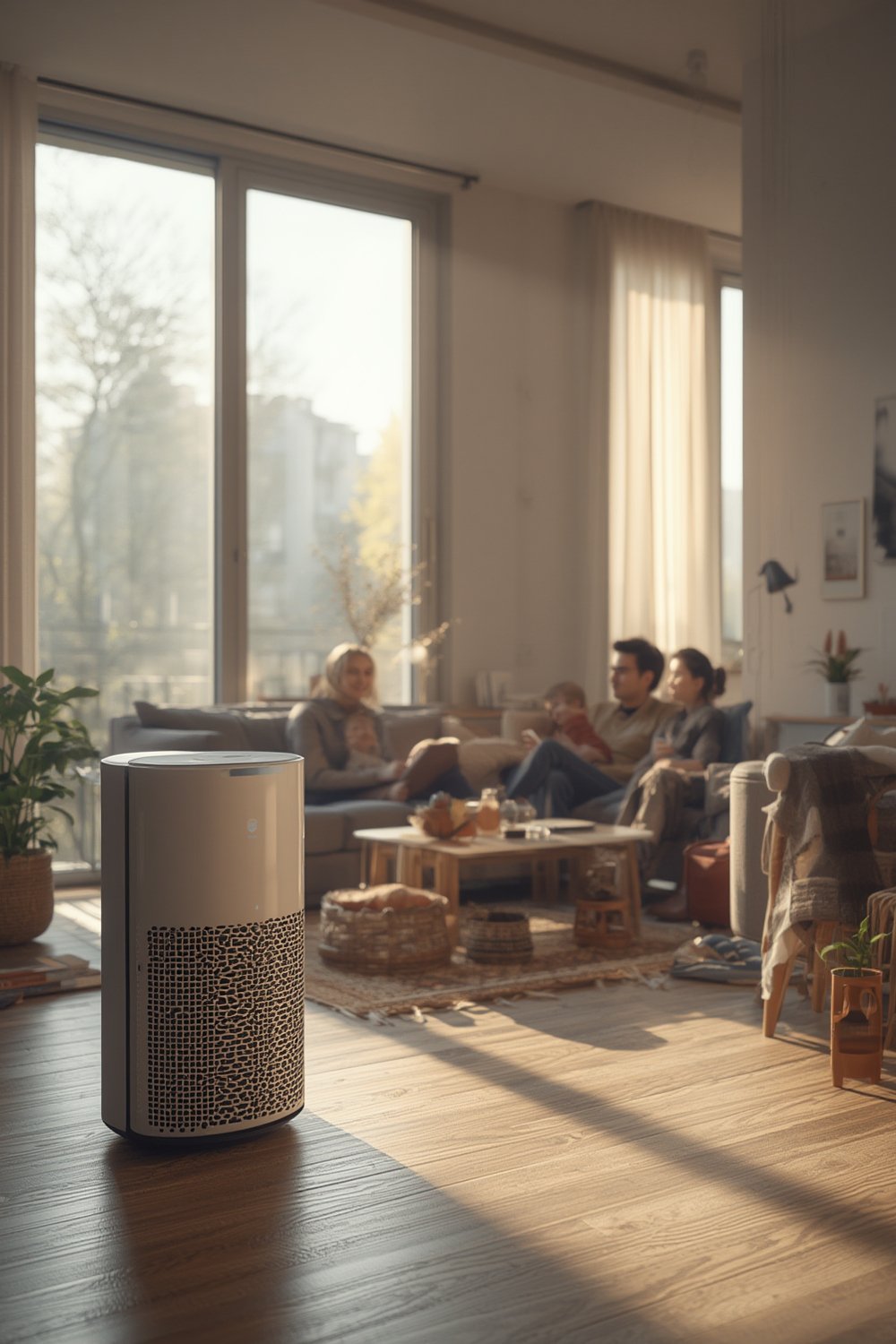
Air purifier listings are full of numbers that sound precise and labels that sound official, yet two machines at the same price can differ several times over in how much air they actually clean. This guide explains the handful of specifications that matter: CADR, true HEPA, activated carbon, noise and running costs. It also covers when smart and portable models are worth it, and gives you a checklist to use on any product page.
We have merged our separate HEPA, smart, portable and “best air purifier” guides into this one page so everything is in one place. For specific situations, see our guides to air purifiers for pets and allergies, bedroom and quiet models and large rooms and whole homes.
What an air purifier can and can’t do
A good portable purifier with a true HEPA filter removes airborne particles: dust, pollen, pet dander, mold spores and smoke particles. With enough activated carbon it can also reduce odors and some gases. It cannot remove dust that has already settled on floors and furniture, it does little for allergens trapped in carpets and bedding, and it doesn’t replace ventilation or fixing a damp problem. Think of it as one part of a plan, alongside regular vacuuming with a HEPA vacuum, washing bedding and opening windows when outdoor air is clean.
1. CADR: the number that matters most
Clean Air Delivery Rate (CADR) measures how many cubic feet per minute (cfm) of filtered air a purifier delivers, tested under the AHAM standard. Most US listings give three figures: smoke, dust and pollen. Smoke is usually the lowest and the most demanding, so use it as your main comparison figure.
The quick rule: choose a purifier whose smoke CADR is at least two-thirds of the room’s floor area in square feet (for ceilings around 8 ft). A 300 sq ft living room needs a smoke CADR of 200 cfm or more.
For allergies or asthma, aim higher, at 4–5 air changes per hour (ACH). You can calculate it yourself:
ACH = CADR × 60 ÷ (floor area × ceiling height)
Example: a 200 cfm purifier in a 250 sq ft bedroom with 8 ft ceilings gives 200 × 60 ÷ 2,000 = 6 ACH. Good. The same purifier in a 450 sq ft open-plan room gives about 3.3 ACH: fine for general use, borderline for allergies.
Be wary of listings that only quote “room coverage” without a CADR. Some calculate coverage at just one air change per hour, which makes a small machine look like it suits a huge room.
2. Filters: true HEPA vs “HEPA-type”
| Label | What it means |
|---|---|
| True HEPA (US) | Captures at least 99.97% of particles at 0.3 microns, the hardest size to catch |
| H13 (EU EN 1822) | At least 99.95% at the most penetrating particle size; comparable for home use |
| “HEPA-type”, “HEPA-like”, “99% HEPA” | Not a standard. Often much less efficient. Avoid if allergies are the reason you are buying |
| Pre-filter | Catches hair and large dust, protecting the main filter. Washable ones save money, especially with pets |
| Activated carbon | Adsorbs odors and some VOCs. A thin carbon-dusted sheet does little; look for granular carbon measured in grams or pounds |
Filter fit matters as much as filter grade. Air that leaks around a loose filter isn’t cleaned. Our filter compatibility guide explains how to check genuine and third-party replacements.
3. Technologies to be careful with
- Ozone generators are sold as “air cleaners” but deliberately produce ozone, a lung irritant. Avoid them.
- Ionizers and some “plasma” or UV features can produce small amounts of ozone. If a model has one, check that it is certified by the California Air Resources Board (CARB), which limits ozone emissions, and choose a model that lets you switch the feature off.
- UV-C lamps inside consumer purifiers usually have too little exposure time to make a meaningful difference to airborne germs. Treat them as a bonus, not a reason to buy.
4. Noise: check the decibels at the setting you will use
Manufacturers often quote noise on the lowest setting, where CADR is also at its lowest. As a guide, about 25–30 dB is a whisper and fine for sleeping, 40–45 dB is like a quiet office, and 50–60 dB is conversation level. A larger purifier running on a medium setting is usually quieter than a small one running flat out to clean the same room.
5. Running costs: the filter price matters more than the purifier price
Before buying, look up the replacement filter price and how often it should be changed (usually every 6–12 months for HEPA, more often for carbon in smoky or smelly homes). A $90 purifier with $60 filters every six months costs more over three years than a $180 purifier with $40 annual filters. Electricity is usually modest: an Energy Star-rated model running all day often costs $15–$50 a year, depending on size and local prices.
| Example over 3 years | Purifier A | Purifier B |
|---|---|---|
| Purchase | $90 | $180 |
| Filters | 6 × $60 = $360 | 3 × $40 = $120 |
| Electricity (approx.) | $75 | $60 |
| Total | $525 | $360 |
Smart purifiers: worth paying for?
Smart models add an air quality sensor, an auto mode and app control. The useful part is auto mode with a particle (PM2.5) sensor: the purifier speeds up when you cook or when pollen comes in, and slows down (quietly) when the air is clean, which can also extend filter life. App scheduling and voice control are conveniences. Be aware that built-in sensors are usually basic and can lag or misread, and that some apps require an account and stop being supported after a few years. Make sure the purifier works fully from its own buttons.
Portable and desktop purifiers
Small desktop and USB purifiers are popular, but most have a CADR well under 50 cfm. That is enough for the air directly around a desk or a very small room, not for a bedroom or living room. If you want one purifier to move between rooms, choose a mid-sized unit with a handle and a CADR of 150–200 cfm rather than a tiny one. For travel and cars, treat small purifiers as a nice-to-have; ventilation and the car’s cabin filter matter more.
Buying checklist
- Measure the room (floor area and ceiling height).
- Find the smoke CADR and check it is at least two-thirds of the floor area, or calculate ACH for allergies.
- Confirm true HEPA or H13, not “HEPA-type”.
- For odors or smoke, check the amount of activated carbon.
- Check the noise level at medium speed.
- Look up the replacement filter price and interval and calculate three-year cost.
- Avoid ozone generators; for ionizers, check CARB certification and an off switch.
- Prefer models with Energy Star rating and a warranty of two years or more.
FAQ
Where should I put an air purifier?
In the room where you spend the most time, usually the bedroom, with at least 30–50 cm of space around the inlets and away from curtains. Don’t push it into a corner behind furniture.
Should I run it all the time?
For allergies, yes, on auto or a low-to-medium setting. Purifiers clean continuously; switching one on for an hour does little once you switch it off again.
Do purifiers help with wildfire smoke?
Yes. True HEPA purifiers are one of the most effective ways to reduce smoke particles indoors. Close windows, run the purifier on high in one “clean room”, and replace the filter sooner afterwards.
How we score products is explained on our how we review page.
[…] This page combines our earlier large-room and whole-home guides. For the basics of CADR and filters, see the air purifier buying guide. […]